Start Your Own TRON RPC Node: Architecture and Requirements in 2026
A detailed breakdown of launching your own TRON node and RPC server: network architecture, technical requirements, costs, and real ROI scenarios in 2026.
Launching Your Own TRON RPC Node: When It Pays Off, Architecture, and Requirements in 2026
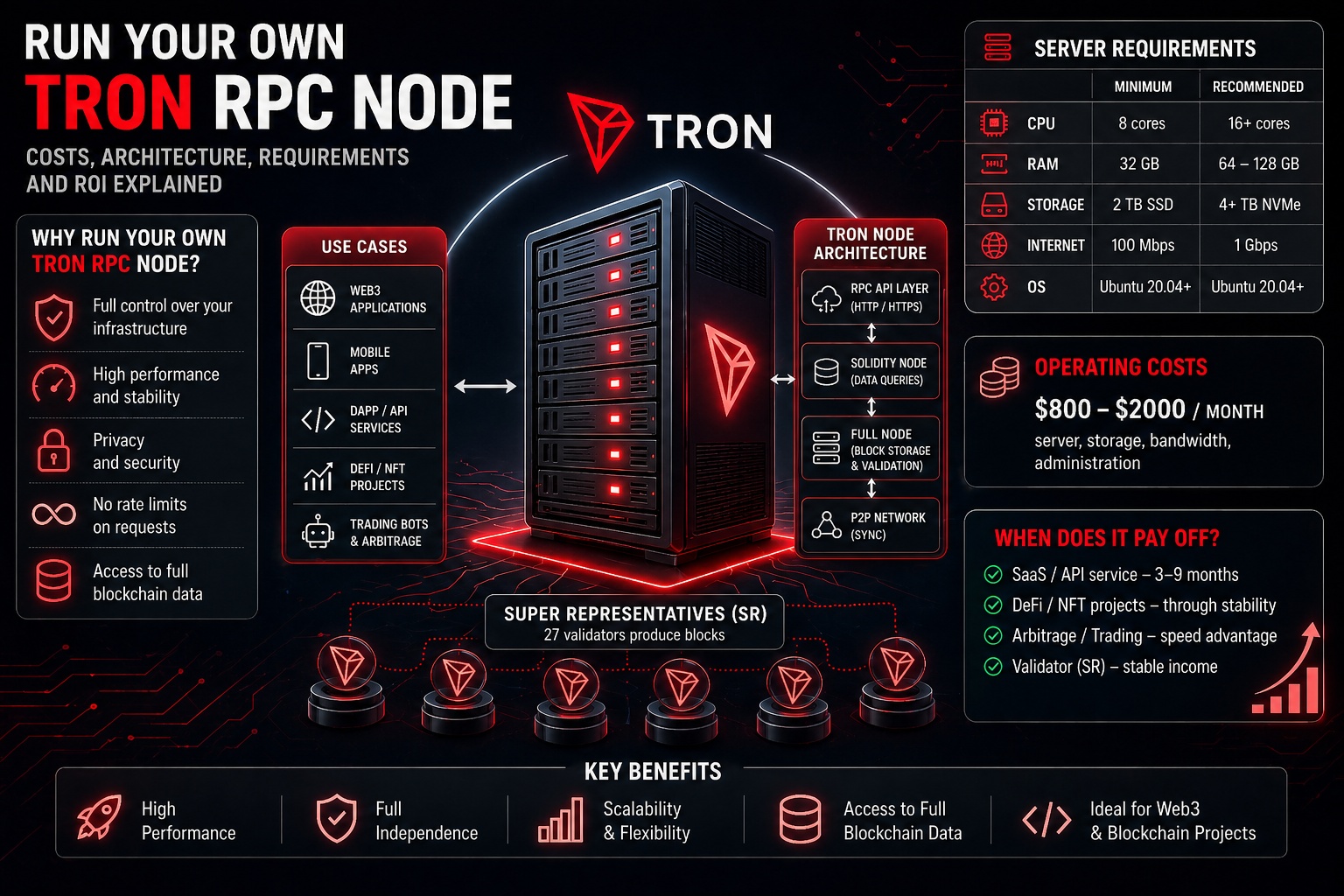
The TRON network remains one of the most in-demand blockchain infrastructures thanks to its high throughput and low transaction fees. This makes it especially popular among DeFi projects, NFT platforms, and payment services. In 2026, interest in running a dedicated TRON RPC node has grown significantly—from both developers and businesses.
Let’s break down when it actually makes sense, how the architecture works, and what resources are required.
What Is a TRON RPC Node and Why Do You Need It?
An RPC (Remote Procedure Call) node is a server that allows applications to interact with the TRON blockchain—sending transactions, querying blocks, smart contracts, and account data.
Without your own node, developers rely on public RPC providers (like TronGrid), which introduces limitations:
Speed Stability Control over data
Running your own node eliminates these issues and provides:
Full infrastructure control No rate limits Better performance Increased privacy TRON Network Architecture
The TRON network uses a Delegated Proof-of-Stake (DPoS) consensus mechanism. Its architecture includes several types of nodes:
1. Full Node
Stores the entire blockchain and processes transactions.
2. Solidity Node
Optimized for reading confirmed data (used for API queries).
3. Super Representative (SR)
Validator nodes that produce blocks. There are only 27, selected through voting.
How the Components Work Together Full Nodes synchronize the blockchain Solidity Nodes handle fast RPC queries The API (RPC layer) serves applications SR nodes produce blocks
This architecture enables load distribution and scalability.
Requirements for Running a TRON Node
Running a TRON node requires significant resources.
Minimum Requirements: CPU: 8 cores RAM: 32 GB SSD: 2 TB Network: 100 Mbps Recommended: CPU: 16+ cores RAM: 64–128 GB SSD: 4+ TB NVMe Network: 1 Gbps Additional: Linux (Ubuntu 20.04+) Docker (optional) 99.9% uptime Cost of Running a TRON Node
Average monthly expenses (2026):
Server: $300–$1500/month Storage: growing over time DevOps/maintenance: $500+
👉 Total: $800–$2000/month
When Does a TRON RPC Node Pay Off?
ROI depends entirely on how the node is used.
1. SaaS / API Service
If you provide RPC access:
Subscription-based revenue ROI: 3–9 months 2. DeFi / NFT Project
A private node reduces:
Latency Downtime risks
ROI here is indirect—through product reliability.
3. Arbitrage / Trading
Speed = profit A private RPC gives a competitive edge → faster ROI
4. Validator (Super Representative)
Requires:
Large TRX holdings Community voting
But can generate steady income.
When You Should NOT Run Your Own Node
While appealing, it’s not always necessary:
Small-scale project No DevOps expertise Low API demand Public RPC is sufficient
In these cases, third-party services are more cost-effective.
Pros and Cons of Running Your Own TRON Node Pros: Full control High performance Independence from third parties Scalability Cons: High cost Operational complexity Ongoing monitoring Continuous updates Final Thoughts: Is Running a TRON RPC Node Worth It in 2026?
Launching your own TRON RPC node is no longer just a technical task—it’s a strategic business decision.
👉 It makes sense if:
You have high traffic Performance and stability are critical You’re building a Web3 product
👉 It does NOT make sense if:
You’re testing an idea Budget is limited You lack infrastructure support
Overall, the 2026 trend is clear: projects are moving toward owning their infrastructure to avoid reliance on centralized APIs.