TRON & USDT TRC20 Fee Myths: Truth About Hidden Costs Explained 2026
We break down the most common myths about fees in the TRON network and USDT TRC20. Discover the truth about hidden costs, exchange fees, and the real price of transactions.
Myths About TRON and USDT TRC20 Fees: The Truth About Hidden Costs and Charges
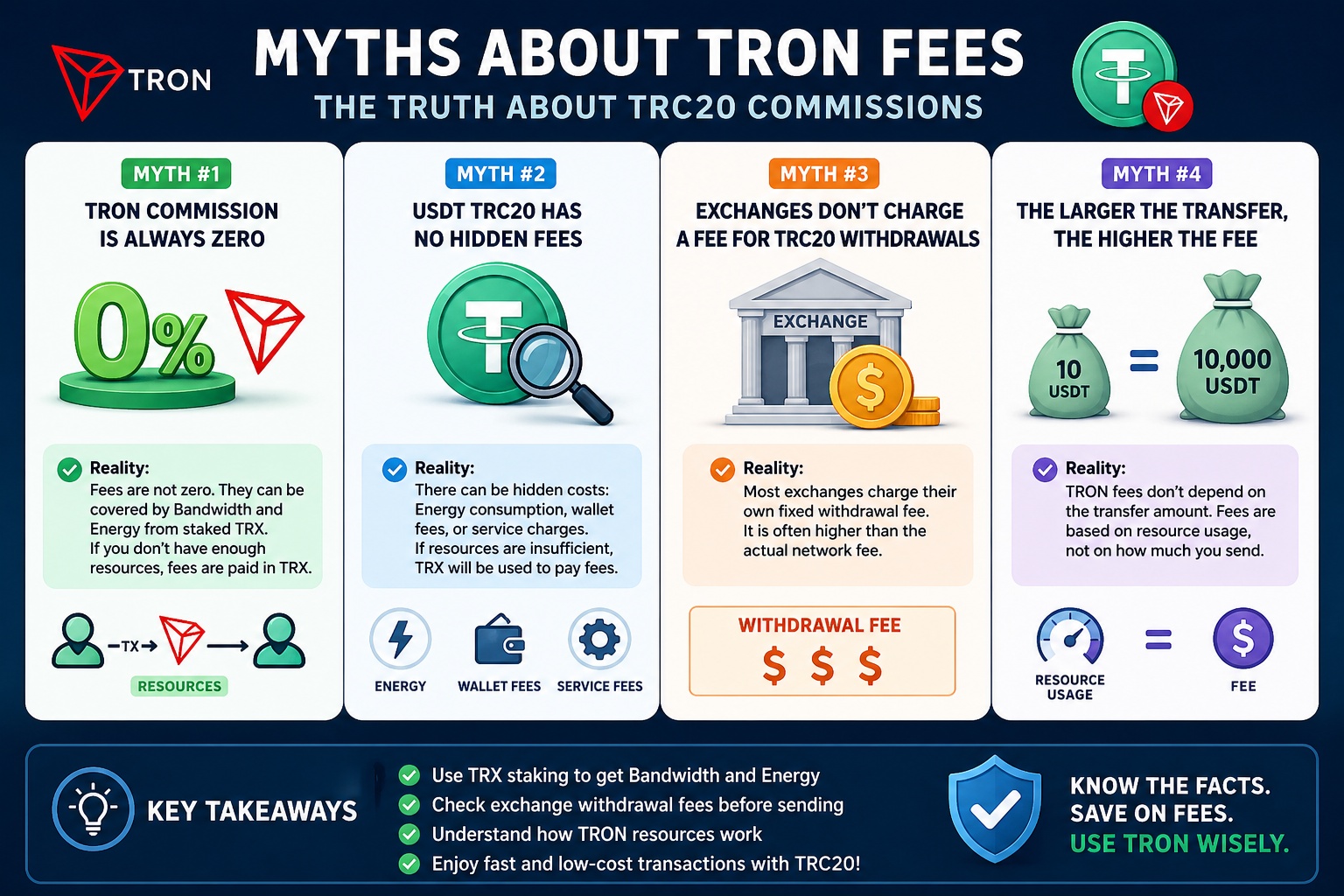
The TRON network and TRC20 standard tokens like USDT have long been considered some of the cheapest options for transferring cryptocurrency. However, many myths about fees have emerged, misleading users. Let’s break down the most common ones and separate fact from marketing exaggeration.
Myth 1: TRON transaction fees are always zero
At first glance, it may seem that transactions on the TRON network are completely free. This belief comes from TRON’s resource model — Bandwidth and Energy.
In practice:
If you have staked (frozen) TRX, you can indeed perform transactions without a direct fee If resources are insufficient, a fee will still be charged in TRX
So, the fee is not actually zero — it’s simply covered by resources or prepaid.
Myth 2: USDT TRC20 has no hidden fees
Many users believe that sending USDT via TRC20 involves no additional costs. This is not entirely true.
It’s important to understand:
Fees may not be obvious but still exist (e.g., Energy consumption) Some services or wallets may include additional charges If resources are insufficient, TRX will be used to pay for the transaction
So-called “hidden fees” do exist — they’re just not always clearly visible to the user.
Myth 3: Exchanges don’t charge withdrawal fees for TRC20
This is one of the most widespread misconceptions. Users assume that since the network is cheap, exchanges won’t charge fees.
Reality:
Almost all crypto exchanges set a fixed withdrawal fee This fee is often higher than the actual network cost Exchanges include operational costs and profit margins
As a result, users may still pay noticeable fees even when using a low-cost network.
Myth 4: The larger the transfer, the higher the fee
This myth comes from traditional banking systems, where fees often depend on the transaction amount.
In the TRON network:
Fees do not directly depend on the transfer amount They are based on resource usage (Bandwidth/Energy) Sending 10 USDT and 10,000 USDT can cost the same
This is one of TRON’s key advantages — predictable and stable fees.
Conclusion
Despite its reputation as a low-cost network, TRON is not completely free. Fees do exist, but they are implemented differently compared to traditional financial systems or other blockchains.
To minimize costs:
Use TRX staking to obtain Bandwidth and Energy Check exchange withdrawal fees before sending Understand how TRON’s internal resource system works
Understanding these nuances will help you avoid unexpected expenses and use TRC20 more efficiently.