Why Are All Cryptocurrencies and TRON (TRX) Falling?
We examine the key reasons behind the cryptocurrency market decline, why Bitcoin, Ethereum, and TRON (TRX) are losing value, how macroeconomic factors, liquidations, and profit-taking impact prices, and what investors should do during a market correction.
Why Have All Cryptocurrencies Fallen in Price, Including TRON (TRX)?
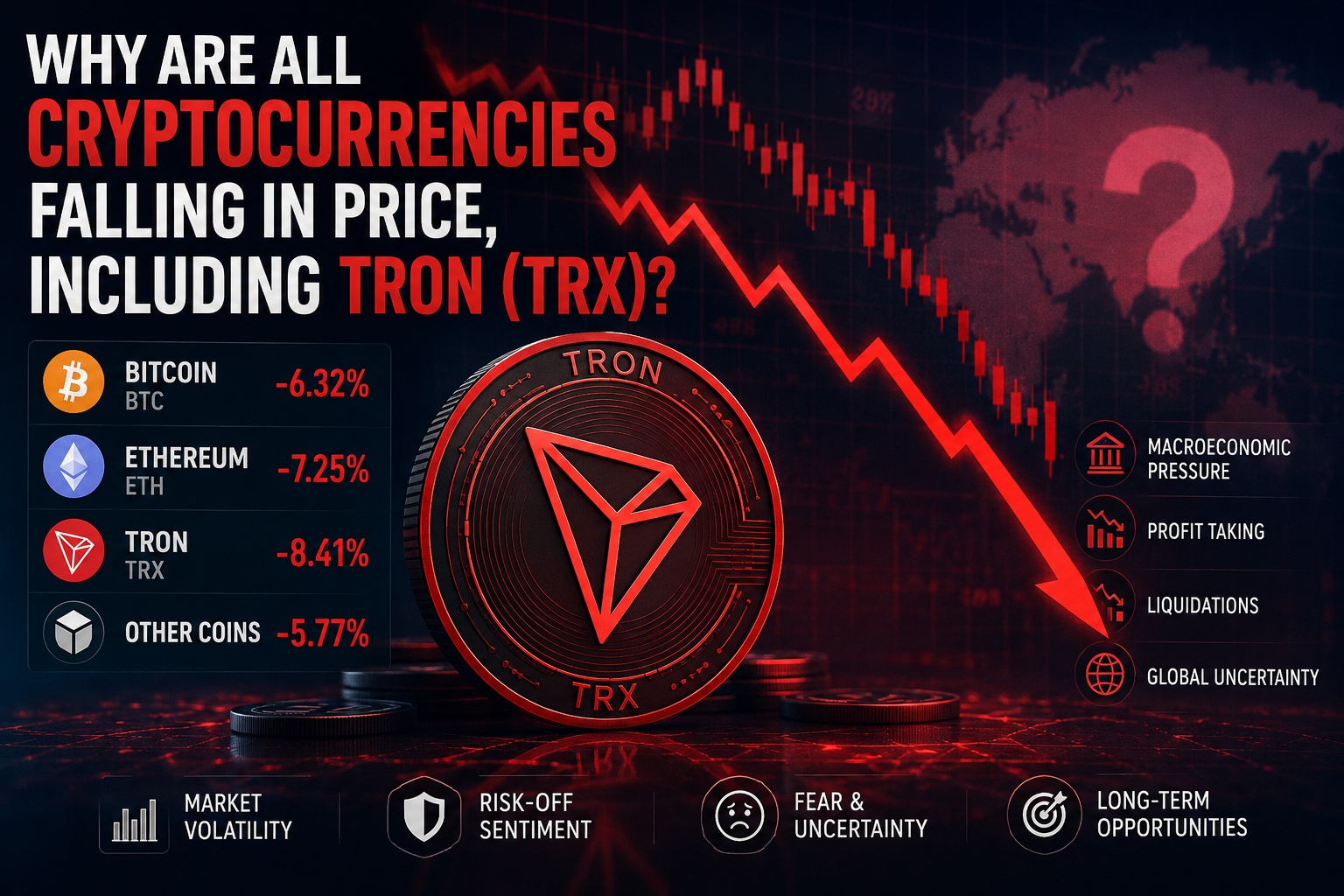
Why Is the Entire Crypto Market Turning Red and What Is Happening to TRON?
If you open cryptocurrency charts during another market downturn, it can feel as if someone pressed a giant red button. Bitcoin is falling, Ethereum is falling, TRON (TRX) is falling, and hundreds of other digital assets are dropping alongside them.
Many investors start to panic and ask the same question: why are all cryptocurrencies falling at the same time, and what is happening to TRON?
In reality, the reasons behind these market movements are usually much deeper than they appear at first glance. And no, Justin Sun did not wake up one morning and decide to crash the price of TRX. Although some traders occasionally seem willing to believe exactly that.
Let's take a closer look at why the cryptocurrency market experiences large-scale sell-offs and how this affects TRON.
Bitcoin Still Controls the Market
Despite the growth of thousands of blockchain projects, Bitcoin remains the primary indicator of the cryptocurrency market.
When Bitcoin starts to decline, investors become more cautious. Large funds reduce risk exposure, traders take profits, and retail investors begin selling assets out of fear of further losses.
As a result, almost all cryptocurrencies tend to fall, even when a particular project has no negative news.
TRON is no exception. The price of TRX is heavily influenced by overall market sentiment.
Macroeconomics Has More Impact Than Most People Think
Cryptocurrencies no longer exist separately from the global economy.
The market is influenced by:
Central bank decisions Interest rates Inflation Stock market performance Geopolitical events Global liquidity conditions
When investors begin avoiding risk, money flows out of highly volatile assets. Cryptocurrencies have traditionally been considered one of the riskiest asset classes.
If major stock indexes decline, the crypto market often follows.
Massive Profit-Taking
After a prolonged rally, many investors begin selling assets to lock in profits.
Imagine a scenario where TRX has increased by 80% to 100% over several months. Large holders may decide to sell part of their positions.
When many market participants do this simultaneously, a correction begins.
This is a completely normal part of every financial cycle.
A market that only goes up exists only in the marketing materials of questionable projects.
Liquidations in the Futures Market
One of the most common reasons for sharp market drops is excessive leverage.
Many traders open long positions using 10x, 20x, or even 50x leverage.
When prices begin to decline, exchanges automatically close losing positions.
This creates a chain reaction:
Prices fall. Liquidations occur. Liquidations create additional selling pressure. Prices fall even further.
This is why the market can sometimes lose tens of billions of dollars in capitalization within just a few hours.
Why Is TRON (TRX) Falling Specifically?
In addition to market-wide factors, there are also project-specific reasons.
The price of TRON may react to:
Changes within the TRON ecosystem Network upgrades Developer activity Regulatory decisions Actions of large token holders News surrounding the project's founder
However, in most cases, TRX remains closely correlated with Bitcoin and the overall cryptocurrency market.
If the entire market is falling, the probability of TRX declining as well remains high.
Does a Price Drop Mean the Project Is Failing?
Absolutely not.
Throughout its history, Bitcoin has experienced dozens of corrections exceeding 30%, and sometimes even more than 70%.
TRON has also gone through multiple major market cycles involving both significant growth and substantial declines.
It is important to understand the difference between:
A temporary price correction Fundamental problems within a project
If the blockchain continues operating, the number of users keeps growing, developers continue releasing updates, and the ecosystem keeps expanding, then a falling price alone does not indicate serious problems.
What Is Happening in the TRON Ecosystem Right Now?
TRON remains one of the most actively used blockchain networks in the world.
This is especially true for USDT TRC-20 transfers.
Millions of users rely on the network daily for international transactions thanks to its speed and relatively low fees.
The TRON Energy rental market is also continuing to grow.
Instead of paying high transaction fees in TRX, users can rent Energy and significantly reduce their transaction costs.
This is why Energy rental services continue to see strong demand even during market downturns.
What Should Investors Do During a Market Decline?
The first rule is simple: do not make decisions based on emotions.
When the market falls, fear causes many investors to sell assets near local bottoms.
It is helpful to ask yourself several questions:
Have the project's fundamentals changed? Why did I buy this asset in the first place? Is my investment strategy designed for the long term? Am I prepared to handle market volatility?
The history of the cryptocurrency market shows that periods of panic are regularly followed by periods of growth.
Conclusion
Cryptocurrency prices fall for a wide variety of reasons, including macroeconomic conditions, Bitcoin's performance, futures market liquidations, and large-scale profit-taking.
TRON (TRX) generally moves alongside the broader crypto market and is strongly influenced by overall investor sentiment.
For long-term investors, it is important to remember that corrections are a natural part of every financial market. In many cases, these periods create some of the best opportunities for future growth.
The key is to stay calm, focus on fundamentals, and avoid making investment decisions driven solely by fear.